Romanian birth certificates — frequently asked questions
Romanian birth certificates are among the most requested documents we handle. Below are the questions clients ask most often — and the answers that match current Romanian civil-status practice and how this office works.
1. Can I get a birth certificate for a deceased parent, grandparent or other relative?
The basic rule is that, once a person has died, the civil-status authority no longer reissues a birth certificate for them. That rule has been reinforced over time to close work-arounds.
Useful paths, when they fit your case:
The person died in Romania — we can obtain a Romanian death certificate, which records the date and place of birth and the parents’ names.
The person died abroad and was a Romanian citizen — the path is to register (transcribe) the death in Romania, then obtain a Romanian death certificate with the birth data.
The person died abroad and was not a Romanian citizen
3.A — A foreign state authority needs the birth record (ministry, court, public notary, police/prosecutor, tax authority, embassy/consulate, etc.). If that institution issues an official letter on its letterhead ordering you — or this office directly — to obtain the record, we can help. The extract is sent by official channels to that institution; we may not be able to share a copy with you, but we can confirm receipt. If the request is addressed to this office directly, the service can be free; if addressed to you, there is a nominal fee.
3.B — A Romanian authority other than the National Citizenship Authority (ANC) needs the record — tell us which authority and procedure; Romanian authorities must request the record inter-institutionally, not through you.
3.C — The record is for the Romanian National Citizenship Authority (ANC) — that is precisely why reissue is barred; we cannot help for that purpose.
Older records (typically before 1918 / over about 100 years): these are normally held by the National Archives. We can undertake archival research for an official extract. That path is for historical / family-history use. For citizenship by descent it may be useful but is not sufficient on its own; see our post on the 2025 rules for citizenship by application. Unless the ancestor left Romania on or after 1949, we cannot advise on citizenship by descent from that record.
2. I was born abroad to a Romanian parent — do I need a birth certificate or a transcription?
If the birth was never entered in Romanian civil-status registers, what you need first is a registration (transcription) of the foreign birth in Romania. Only after that can a Romanian birth certificate be issued from the register where the transcription was made (often Bucharest Sector 1 for many consular / abroad cases — the competent office depends on the facts).
Transcription / registration work is done under a notarised power of attorney (PoA), not under the office’s legal-assistance contract used for certificate retrieval alone.
3. Do I need a notarised power of attorney for my own birth certificate?
For obtaining your own Romanian birth certificate (or your minor child’s) through this office: no notarised PoA is required. Since October 2020 we work on a legal assistance contract, which we prepare for your signature (and scan back).
A notarised PoA is still required for other work — in particular registration / transcription of foreign births, marriages or deaths, and any mandate that goes beyond certificate retrieval, multilingual extracts, celibacy / nulla osta, archival extracts, criminal records, and similar contract-only services listed on our site.
4. My name or spelling changed abroad — what do I need?
Romanian civil-status offices issue certificates under the identity recorded in the register. If your current ID does not match that identity, you must prove the change with an unbroken chain of official documents (marriage, divorce, naturalisation, name-change judgment, etc.), properly apostilled or legalised as required for the issuing country, plus an authentic (certified) translation into Romanian where needed.
If you are still a Romanian citizen, proving the foreign change is not enough: every foreign vital event must also be registered in Romania (an absolute, time-unlimited duty). Until that is done, a new Romanian certificate under the new name will not issue.
If you are not a Romanian citizen, the proof chain alone is what the office needs for the request.
An ID card or passport alone is never proof of a name change; there must be an underlying civil document (with limited country-specific exceptions we will flag if they apply).
5. Do I need an Apostille, legalisation, or a multilingual extract?
Use inside the European Union: a Romanian birth certificate is recognised in EU member states without an Apostille.
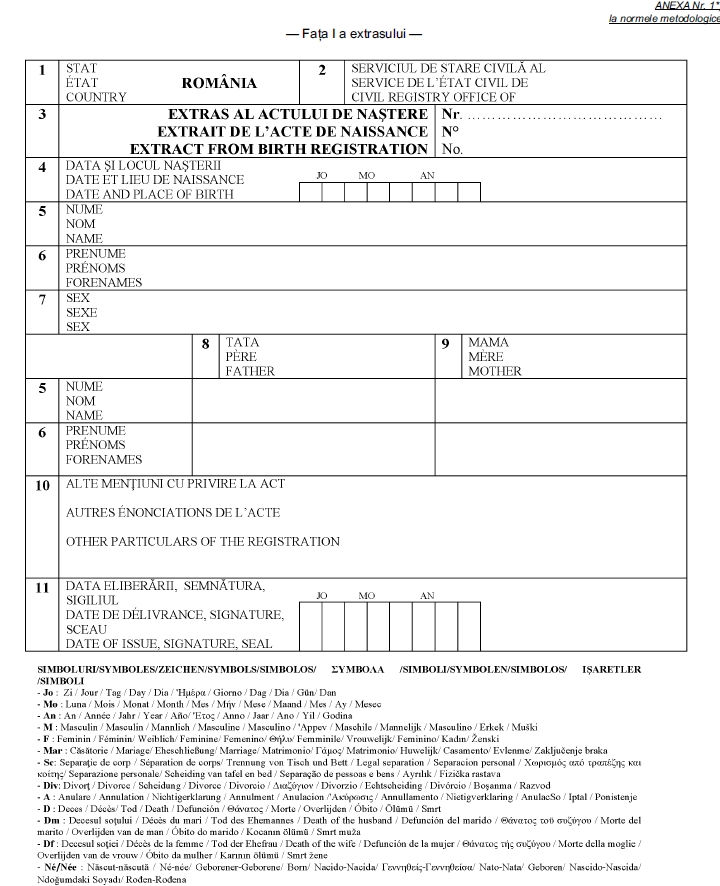
Multilingual extract (CIEC Convention No. 16): where that Convention applies for the receiving country, a multilingual extract can avoid a separate translation. It is not a substitute for every foreign procedure — check the destination.
Outside the EU / where Apostille is required: we can include an Apostille (and authentic translation into the language of use) in the cost proposal.
Countries with bilateral exemptions from legalisation for certain documents: see our Exemptions page (linked from Apostille / Legalisation; not a main-menu service).
Tell us where the certificate will be used so we can propose the right format.
6. Is a Romanian birth certificate proof of citizenship?
No. A birth certificate records civil-status facts (birth, parents, place). It is not a citizenship certificate. A CNP (personal numeric code), when present, is at most a clue, not proof of Romanian citizenship. Citizenship status depends on separate rules and, where needed, separate procedures.
7. How long does it take through the office?
As a current office practice (not a legal deadline), certificate files handled through us typically take on the order of about six months, depending on the issuing municipality and whether Apostille / translation is included. Collecting the certificate yourself in person at the competent office is usually much faster (days to a few weeks when the file is straightforward).
8. When do I pay?
Payment is due only after we have a clear path forward, a signed contract, and any required documents from you. Payment is by secure PayPal invoice (card, Venmo, or PayPal funds).
Next step: Start with our enquiry form.


Comments